 |
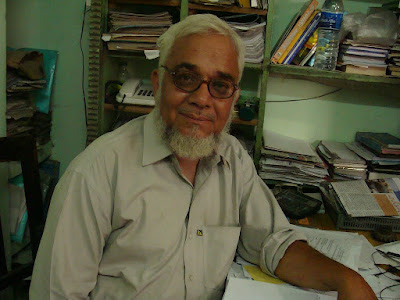
Reyaz Azimabadi, journalist and author
NK SINGH
|
I met Reyaz Azimabadi for the first time at a Patna tea shop -- the best place to meet, considering that we thought of ourselves as budding intellectuals.At the age of 17, he was already the Editor of Masael, an Urdu weekly. And by the time I met him at that roadside tea shop in Patna, I considered myself a veteran journalist at the age of 18; I was already freelancing for a number of daily newspapers and weekly magazines.
The year, if I recall correctly, was 1969.
Failing to secure accommodation in the hostel of BN College, where I was pretending to study for my graduation in English Honours, I had rented a room on the second floor of a shopping complex in the crowded Langartoli area.
The shopping complex was owned by a fisherman – Machuatoli, the fishermen’s district, was just round the corner – a massive potbellied man with two wives and a bagful of bawdy stories about Angrez sahibs that left nothing to imagination.
The teashop was on the ground floor, a regular haunt of students, low-paid clerks and medical representatives. Reyaz, whose office was in the same locality – bang opposite Ajay Bhawan, the CPI headquarters – frequented it several times in the day for chai and conversation.
Reyaz was a short, fair and handsome boy. He looked cute. He was progressive in his thoughts, intolerant of religious dogmas and fiercely opposed to communal biases. He also believed in tehjeeb and decorum at an age when most boys revelled in using four-lettered words.
He told me that despite his young age, he was already independent and lived away from his family because Masael brought enough income for his upkeep.
We became friends. He was my first insight into Muslim psyche.
He also offered me my first window to Urdu journalism. Often, I would tag along on his visits to katibs-- the calligraphers who, stooped over their low-desks, kept churning out flawless, beautiful pages on rice paper. Their work would finally be transferred to a lithograph machine for printing.
The katibs were capable of beautiful calligraphy with amazing speed, a necessity for producing daily newspapers. They were highly skilled, literate artists, many of them masters of grammar of Urdu and its nuances. Alas, they were also among the lowest paid staff in the publication industry.
Subsequently, Reyaz would help me set up a branch of Sampradayikta Virodhi Committee, the anti-communal front led by Congress MP Subhadra Joshi.
Besides keeping Masael, which means Issues, alive till 1974, he worked with Hindi Blitz, Jagran, Secular Democracy, Indian Nation, Aryavarta and several other publications in his long and illustrious career. He was awarded the prestigious Times Fellowship in 1994.
Reyaz Azimabadi died of heart failure in April 2021. I plan to share some articles that we co-authored on the minority issue. Same space, tomorrow. That is my Farewell to a defender of secular values.
 |
| Urdu calligraphy sees a revival. Pic courtesy The Hindu Businessline |

Comments
Post a Comment
Thanks for your comment. It will be published shortly by the Editor.